A Pernem pilot · complete concept note
Mandrem Community
Data Centre
Our data. Local intelligence. Shared prosperity.
By Moses Sam Paul Johnraj ·
A proposal for community ownership of local storage, computing and small-language-model services. Mira’s fictional yoga moment illustrates one record journey within that wider institution.
Explore the illustrated journey ↗ · Read the companion essay ↗
Proposed pilot, illustrative costs and fictional records. No operating facility, registered member institution, government partnership or tested model is claimed.
The proposal
The central proposal is local ownership of storage, computing and useful small-language-model services. A member-governed installation in Mandrem would host distinct personal, community, organisation, licensed-knowledge and authorised civic collections. It could become a community revenue stream through paid services and accountable work.
The Internet of Value supplies a language for relationships among activity, lived context, evidence, community judgment and a consent-governed identity view. Fictional Mira’s yoga practice illustrates one kind of record; it does not define the centre’s whole purpose.
Start in Mandrem, within Pernem taluka. Assess a wider Pernem network only after demand, operations and governance have been tested. The planning budget, service demand, legal form, model choice and site remain proposed. No operating facility or institutional partnership is claimed.
The infrastructure problem
Large data centres and large language models provide useful broad capacity. Local communities also need a route to owning and governing some of the infrastructure serving their records and knowledge. Attracting a facility to a region does not automatically give residents ownership or a governing voice.
The proposal joins three choices: local physical capacity, member governance and a compact model for bounded tasks. Model size, data location and ownership are independent dimensions: a compact model can run in a large cloud, and a local facility can remain externally owned. The pilot must make its chosen combination concrete.
The IEA’s 2025 report estimated data-centre use at about 415 TWh in 2024. Its 2026 analysis discusses growing infrastructure trade-offs. Neither establishes a Mandrem energy problem or proves local equipment will be more efficient. Measure whole-service power and cost alongside usefulness. IEA 2025, IEA 2026.
The existing landscape
Existing layer | Established role | Proposed Mandrem relationship |
|---|---|---|
Large data centres and model services | Broad computing capacity and large-model training or inference | Use defined wider capacity while assessing bounded local services; no claim to replace every large workload |
Goa State Data Centre | Government application infrastructure described in the 2021 IT Citizen Charter | Explore authorised services or recovery arrangements with the responsible institution; no agreement exists |
Cooperative digital services | CommonsCloud describes member/worker co-ownership, fees and an operating team | Learn from a real cooperative-service precedent without assuming its economics or legal form transfer to Goa |
IoV protocols | A canonical grammar for activity, lived context, qualified community flows and identity disclosure | Proposed meaning and lineage layer; storage software and model permissions still need implementation |
The Mandrem pilot combines community ownership, a local physical installation, distinct collections, IoV meaning and compact-model services. The combination is an operating proposal to test, not a claim that local computing or cooperatives have just been invented. IEA evidence supplies broader context, not a local impact assessment.
The argument and its sources
Data Ownership and the Policy Environment, by Joel John and Moses Sam Paul, was published on 25 December 2020. It distinguished privacy and ownership and argued for member-oriented data cooperatives.
Data Ownership and the Community Platform: Use Case, published on 6 April 2021 by the same authors, connected individual control, community validation and portable records.
This proposal extends that institutional question to the physical infrastructure and local inference. The publications do not report a Mandrem pilot or prove this service model. Their earlier policy context is historical; current legal design needs a fresh assessment.
Relevant precedents include CommonsCloud’s cooperative services and the economic questions in Jones and Tonetti’s nonrival-data model. The companion Insights essay develops the argument in full.
Mandrem as the starting area
Mandrem Village Panchayat sits within Pernem taluka/block in North Goa. Mandrem is also Assembly constituency No. 1; Pernem is a separate Assembly constituency No. 2. Start with the panchayat service catchment and resident participation, rather than treating the Assembly constituency as the operator or data owner. The eventual infrastructure catchment may include several villages while each community retains defined governance rights. Official Goa panchayat listing, CEO Goa constituency profile.
The panchayat and Gram Sabha are potential civic partners. A cooperative membership body is a separate institution; its membership and voting rules must be legally constituted. Tenants, migrant workers, women, unpaid carers and people without smartphones need practical routes to participate. No political office, shareholder or technical operator receives blanket access to personal records.
The centre, the records and the small model
Begin in existing premises with application/inference computing, storage, networking, power protection, environmental management, monitoring, a tested backup plan and paid operators. Replace generic equipment assumptions with site and workload quotations. The installation’s actual service level must match what can be maintained.
Five candidate collections are personal workspaces; restricted community evidence and review records; organisation workspaces; licensed local knowledge; and authorised civic or environmental material. Each has its own rights, audience, purpose and retention rules. Collective ownership of the equipment is not shared access to all records.
Run an appropriately licensed pretrained small language model with permission-controlled retrieval. Authorisation happens before a passage enters the model. Responses should identify source and version and recognise missing evidence. Test local language and task performance; the protocol grammar itself is not a natural-language model.
The Phi-3 report provides an example of compact-model local inference, not a Mandrem model recommendation. RAG research motivates separating model parameters and retrievable knowledge. Personal records are not default training data; fine-tuning needs a separate rights and evaluation decision.
Test key custody, operator privileges, tenant isolation, permission withdrawal, source correction and index deletion. An off-site encrypted recovery copy requires a declared locality exception. Access revocation cannot recall an already downloaded copy or override applicable retention duties.
How the four protocols fit
Canonical protocol | Pilot application | Boundary |
|---|---|---|
|
| Capturing an account is not validation; the original narrative remains distinguishable from inference. |
| Personal context can be interpreted with subject confirmation. Eligible | Private experience need not become a public contribution or credential. |
| Eligible outputs enter | Private yoga can bypass review. An optional demonstrated learning output may enter |
| A living state receives eligible validated updates. | A selective credential does not reveal the whole identity or the private source account. No automatic score increase or payment follows. |
The current capture schema does not define a dedicated first-person experiential-account element. Preserve the original account as application data and retain source, language, translation and confirmation provenance while that Spec question remains open. This proposal adds no fifth protocol and changes no canonical schema.
The current identity specification treats final protocol valuation as non-payable. Actual pay, cooperative shares and surplus distribution require legal agreements, financial records and bank settlement. Canonical identity and disclosure specification, SAO capitalization interface.
One lived moment and its data route
At a local yoga studio, fictional Mira practises for 25 minutes. Her first-person account is: “I arrived tense. By the end of the practice, I felt steadier.” The practice, her account, a teacher’s observation and any later review are distinct records. A personal report does not establish a biochemical change, clinical improvement or an increase in ~~~WellbeingScore.
The important sequence is private capture and storage, then optional selected review and a linked receipt. Mira can keep the practice private. A wellbeing circle receives an excerpt only if she chooses; a separate request for review of an eligible demonstrated learning output can activate ~SAOcommons. The walkthrough makes both routes available.
Stage | What exists or moves | Where it is stored | Who can see it |
|---|---|---|---|
Capture | Time, task, original account and selected proof form a private draft | Her phone until sync | Mira |
Private sync | Encrypted source record with access policy | Her personal namespace in Mandrem | Owner and explicitly authorised processing roles |
Personal confirmation | She confirms, corrects or withholds structured interpretation | Personal context beside its source | Mira; selected support only by a separate grant |
Optional wellbeing support | One selected excerpt or practice record | Restricted support workspace with agreed retention | Named support circle for its stated purpose |
Optional skill review | Selected yoga practice evidence and teacher observation, excluding private reflection | Permissioned review workspace referencing the source | Qualified, conflict-checked reviewers |
Optional skill decision | Bounded attestation, reasons, issuer, criteria and appeal route | Review record; linked receipt returns to Mandrem | Owner and authorised review roles |
Personal return | Private practice history, or an eligible attestation if review was requested | Her consent-governed identity state | Owner; later selected audiences |
Knowledge contribution | A separately licensed studio class guide and timetable | Shared or audience-limited knowledge collection | The guide’s authorised audience |
Assistant | Permitted passages are retrieved for a question | Local search index and inference context | Requester within the same access scope |
External use | A minimal selected claim or contracted service output | Recipient only under a defined arrangement | Named recipient for a defined purpose |
Income | Actual invoice and bank receipt for the service | Financial records separate from personal vaults | Finance roles and redacted member reporting |
Withdrawal | Revocation, access change, index invalidation and processor instructions | Policy and lifecycle records | Owner and narrowly authorised roles |
A wellbeing support circle may witness a practice or offer support; it cannot independently prove Mira’s inner experience or infer clinical improvement. Qualified yoga teachers may review selected practice evidence against agreed criteria. A bounded observation such as “followed this beginner routine under guidance” does not certify mastery or teaching ability. Private practice requires no skill attestation.
Community ownership and accountable operation
Explore registration under the applicable Goa cooperative framework, with the Registrar confirming classification, membership, capital, voting and surplus rules. A working governance design has a member assembly and a five-seat board: three resident representatives, one worker representative and one participating-institution representative. These seat choices are provisional; lawful bylaws govern the final arrangement. Goa’s Registrar is the relevant registration and oversight route. Goa Registrar of Cooperative Societies.
Decision | Proposed accountable authority |
|---|---|
Personal disclosure or a training contribution | The person or applicable rights holder through a specific permission |
Organisation workspace use | The responsible organisation, within its lawful authority |
Annual plan, prices, major contracts and lawful surplus allocation | Member governance under the bylaws |
Routine technical operations | Trained operators with limited permissions and recorded access |
A contribution judgment | Qualified reviewers under declared criteria, conflict rules and quorum |
A contested judgment | An appeal reviewer or body independent of the original decision |
Spending and bank payments | Authorised signers, with dual approval above an agreed limit |
Complaints about operators or the board | An independent, accessible grievance route |
Separate rewards for work from democratic membership rights. Voting, essential services and participation must not depend on a ~~~WellbeingScore or personal-data disclosure. Publish redacted financial accounts and decision reasons, without publishing private activity or health information. Establish portability, operator replacement, member exit and winding-down procedures before collecting substantive personal data.
The 2020–2021 articles provide the institutional thesis; their 2019 Bill discussion is historical. Use the DPDP Act 2023 and final 2025 Rules with their phased commencement. Determine fiduciary and processor roles for each actual service; cooperative ownership does not automatically resolve those responsibilities or make the pilot a registered Consent Manager. DPDP Act, final Rules.
Services for members and external institutions
Customer or participant | Initial offering | Who pays and what they receive |
|---|---|---|
Individual member | Private files, assisted access, export, chosen evidence sharing and an authorised knowledge assistant | Modest optional service fee or sponsored access; personal records are not the price of membership |
Shop, association or other local organisation | Separate workspace, backups, document search and support | Subscription and onboarding fee tied to storage, users, support and permitted processing |
Skill-based community | Evidence intake, reviewer workspace, bounded attestation and appeal records | Community or commissioning organisation funds the service; payment does not buy a favourable judgment |
Wellbeing support community | Permissioned practice or excerpt sharing with clear scope and expiry | Member or programme funds facilitation; no diagnosis or employment screening |
Authorised government department or integrator | Local digitisation, assisted digital service, document quality checks or purpose-limited verification | The commissioning body contracts an agreed deliverable under procurement and data authority |
External model or cloud organisation | Community language evaluation, licensed knowledge production or later qualified edge work | Contracted deliverable with contributor rights, use restrictions and an agreed benefit arrangement |
Do not sell access to private diaries or comprehensive resident profiles. Research or aggregate services need a separate purpose and privacy assessment: small-area statistics can identify people even when names are removed. No external customer demand is assumed in the base launch decision.
A possible relationship with Goa State Data Centre
Goa already has a State Data Centre at IT Hub, Altinho for government websites and applications. Mandrem should explore a complementary local service role, with the responsible department, ITG or an authorised integrator defining authority and procurement. The facility itself is not automatically a buyer of resident data. Goa State Data Centre circular, ITG role.
Possible exchange | Direction of value | What must be established |
|---|---|---|
Local onboarding, authorised digitisation and document support | Department or integrator pays Mandrem for a service | Department mandate, procurement, quality criteria and data-processing agreement |
A permitted credential or service verification API | A minimal result reaches a named recipient | Issuer authority, disclosure scope, purpose, expiry, audit and recipient obligations |
Encrypted recovery or approved hosting | Mandrem purchases or receives eligible hosting capacity | Access eligibility, key custody, residency, restore targets, retention and charges |
Licensed local language or knowledge work | Buyer pays for a defined corpus or evaluation | Rights-holder agreement, licence, permitted uses and contributor compensation |
Later edge processing or infrastructure subcontract | External operator pays for measured capacity or support | Workload fit, connectivity, security and qualification against actual service levels |
Only the first two service discussions need to be explored during the pilot; production integration is not required to prove local usefulness. Do not offer government-grade disaster recovery or spare GPU capacity before demonstrating that capability. No partnership, contract, eligibility or public-record transfer has been established.
Costs and funding assumptions
All figures are cash planning allowances in INR, dated 16 November 2026, with a provisional allowance for applicable taxes where purchases or services are taxable. Tax treatment and input-credit assumptions must be replaced by quotations and accounting advice before a funding request is finalised. Staffing is funded rather than treated as free volunteer labour. The model assumes existing premises and excludes land acquisition, new construction, a large GPU cluster, telecom resale infrastructure and formal facility certification.
Equipment and site adaptation | Base allowance in lakh |
|---|---|
Compute and a small inference machine | 2.60 |
Storage, disks and backup media | 1.80 |
UPS and electrical work | 0.85 |
Network, firewall and installation | 0.60 |
Secure room, rack and cooling adaptation | 1.35 |
Equipment subtotal | 7.20 |
Readiness work | Base allowance in lakh |
|---|---|
Legal structure, bylaws and agreements | 0.65 |
Independent security assessment | 0.70 |
Onboarding, translation and service setup | 0.75 |
Readiness subtotal | 2.10 |
Monthly operation | Base allowance in INR |
|---|---|
Technical operator | 55,000 |
Community coordination and support | 40,000 |
Engineering and security support retainer | 55,000 |
Premises contribution and electricity | 25,000 |
Connectivity and recovery services | 15,000 |
Administration, insurance and other operation | 20,000 |
Monthly cash operation | 2,10,000 |
Ninety day cash requirement | Base allowance in lakh |
|---|---|
Equipment and adaptation | 7.20 |
Readiness | 2.10 |
Three months operation | 6.30 |
Subtotal | 15.60 |
Contingency at 15 percent | 2.34 |
Gross 90 day allowance | 17.94 |
The low case assumes ₹4.50L equipment, ₹1.50L readiness and ₹1.50L monthly operation: ₹12.075L including 15% contingency. The high case assumes ₹10.50L equipment, ₹3.50L readiness and ₹3.00L monthly operation: ₹26.45L including the same contingency. These are sensitivities, not a confidence interval.
For ongoing operation after purchase, add ₹20,000/month as an illustrative replacement reserve, equivalent to ₹7.20L over 36 months: ₹2.30L/month. Do not add that reserve again to the 90-day cash budget as if it were another equipment purchase. The fee examples below are revenue before indirect taxes; confirm collection and tax treatment in the final model.
Airtel publishes office-plan examples, while dedicated access requires a site survey and quotation. Those examples do not establish Mandrem availability, two independent routes, hosting suitability or an SLA. Dedicated access requires a site survey and quotation. Hardware and service allowances above are not derived from a priced bill of materials. Obtain at least two written local equipment and connectivity quotations before procurement. Airtel office plan example, dedicated service and survey.
Revenue and the support gap
Illustrative monthly activity | Assumed price | Income in INR |
|---|---|---|
20 paying organisation workspaces | 1,500 | 30,000 |
Two anchor service contracts | 20,000 | 40,000 |
40 paid personal accounts | 100 | 4,000 |
Four support or knowledge service jobs | 5,000 | 20,000 |
Total illustrative income | 94,000 |
At these assumptions the service covers about 40.9% of the ₹2.30L ongoing monthly requirement and needs ₹1.36L/month of support. Against cash operation alone, the gap is ₹1.16L/month. The gross 90-day budget assumes no revenue is collected; it does not deduct hoped-for subscriptions. Signed contracts, actual invoices and cash receipts must be reported separately.
A sponsor, grant or public-interest service contract would therefore fund the experiment. If a next phase cannot cover costs, it needs an explicit recurring subsidy or a redesigned service. Increasing customer counts may increase support, storage and security costs; the interactive calculator holds the base cost fixed only to show sensitivity within assessed capacity.
Actual revenue pays wages, service delivery, maintenance and agreed reserves before any lawful surplus allocation. Early community benefit may be employment, reliable services and reduced institutional friction. No household dividend, data sale price or guaranteed return is assumed.
The first 90 days
The pilot clock starts after a sponsor, accountable operator and host site are agreed. Phase gates limit expansion; they do not require residents to reveal more data to keep participating.
Period | Work | Tangible output and gate |
|---|---|---|
Days 1–30 | Resident workshops; membership and legal design; source and permission inventory; site, power and connectivity survey; willingness-to-pay interviews | Community charter, responsibility map, local quotations, a permitted corpus and two priced anchor letters of intent before equipment commitment |
Days 31–60 | Install a modest service; demonstrate private storage/export and one bounded review; operate an organisation workspace; evaluate document retrieval and local-language tasks | Tested tenant boundaries and recovery; owner-understood grants; one working paid service before broader collection |
Days 61–90 | Exercise appeals, conflicts, correction, expiry and withdrawal; restore from recovery copies; test wrong-person requests and adversarial documents; collect invoices and user evidence | Member-reviewed scorecard, actual unit costs and receipts, security findings and a funded stop/redesign/continue decision |
Test | Proposed acceptance target | Evidence to retain |
|---|---|---|
Consent comprehension | At least 80% of tested participants correctly explain who receives a selected packet and how to withdraw | Script, participant count, language, task and incorrect answers |
Access boundaries | Zero unauthorised disclosures in a documented adversarial test set; any breach pauses expansion | Wrong-person, cross-organisation, revoked-grant and malicious-document tests; remediation |
Community review | Exercise agreement, disagreement, conflict recusal and at least one appeal using synthetic cases | Criteria, qualified reviewer roles, decisions and independent appeal record |
Assistant usefulness | At least 85 acceptable answers out of 100 locally reviewed questions, with a supported answer or appropriate refusal | Published rubric; source correctness; language and task breakdown; latency and cost |
Recovery | Demonstrate restore within 8 hours with no more than 24 hours of data loss | Timestamped drill, restored records and failure notes; a test target rather than an SLA |
Willingness to pay | At least 10 businesses make one payment; both anchor institutions state renewal terms and price | Invoice, receipt, retention decision and support effort |
Governance | Exercise one spending vote and one appeal; publish redacted finances and reasons | Participation, conflicts, outcomes and member comprehension |
Personal return | Participants can retrieve, correct and export their own record without revealing unrelated facets | Observed task completion, failures and assistance required |
Set the consent-test sample and language coverage before recruitment closes. The 100-question AI set must include source absence, conflicting sources, language/script variation and requests that should be refused. Averages must not hide weak performance for one group. Test offline drafts and failed sync without claiming a record has been safely saved when it has not.
Next steps before commissioning
Use the next two weeks to turn the revised story into a community decision. The sequence below is proposed; no meeting, outreach or expenditure has been arranged.
Step | Proposed participants | Concrete output |
|---|---|---|
Convene a founding group | Residents, a yoga community, a business association and an accountable operator | Named roles, inclusion rules and a co-design workshop |
Test the moving-wallet story | A small, deliberately varied group of residents using their preferred languages | Observed misunderstandings about storage, disclosure, review and withdrawal; a revised flow |
Choose one useful paid service | Potential organisation customers and service operators | One service specification and two priced anchor letters of intent |
Check the legal and physical route | Registrar or legal adviser, host-site representative and technical operator | Draft charter, rights and retention map, site assessment and at least two local quotations |
Make a funding decision | Founding group and prospective sponsor | Fund a defined 90-day pilot, redesign it or stop, with reasons |
Approach Goa ITG or a responsible department with a specific permitted service and a question about the qualification route. A general transfer of resident records is not part of that proposal.
Before commissioning, review the service demand, governance, site, recovery plan and full cost evidence together. The ₹17.94 lakh gross 90-day allowance remains a planning model; the current revenue assumptions require explicit support. No pilot rollout, partnership or funding decision follows from approving the visual concept.
Source of Truth
Protocol meaning comes from the hosted IoV registry, checked at version 0.7.0 with production-candidate status, and canonical source repositories. The Foundation website and this concept note do not define protocol truth.
The 2020 and 2021 articles supply institutional ideas, not current legal authority. Figures, governance seats, prices, recruitment scale and acceptance thresholds in this note are proposed design assumptions. External service relationships remain hypotheses to test.
Questions about the Mandrem pilot
What is the Mandrem Community Data Centre?
It is a proposal for a member-governed local institution combining storage, computing and useful small-language-model services in Mandrem, within Pernem taluka, Goa. No operating facility or government partnership is claimed.
What data would the centre host?
The proposed collections are personal accounts, community evidence, organisation workspaces, licensed local knowledge and authorised civic material. Each would have separate rights, access rules and purposes.
Would Mira’s private yoga reflection train the model?
No automatic training or disclosure is proposed. Fictional Mira’s chosen personal record stays separate from any selected review evidence. The initial model service would retrieve only material the requester may access.
How would the centre earn money?
Possible income comes from supported storage, organisation workspaces, backups, local support and authorised institutional services. Fees must cover operating costs and reserves before any governed distribution. Demand and prices are unconfirmed.
What is the proposed pilot budget?
The first-90-day planning allowance is ₹17.94 lakh for an initial installation in existing premises. The illustrative monthly scenario has ₹94,000 service income against ₹2.30 lakh in operation and reserves, leaving ₹1.36 lakh of support needed. These are unquoted assumptions, not committed funding or guaranteed returns.
Is the centre connected to Goa State Data Centre?
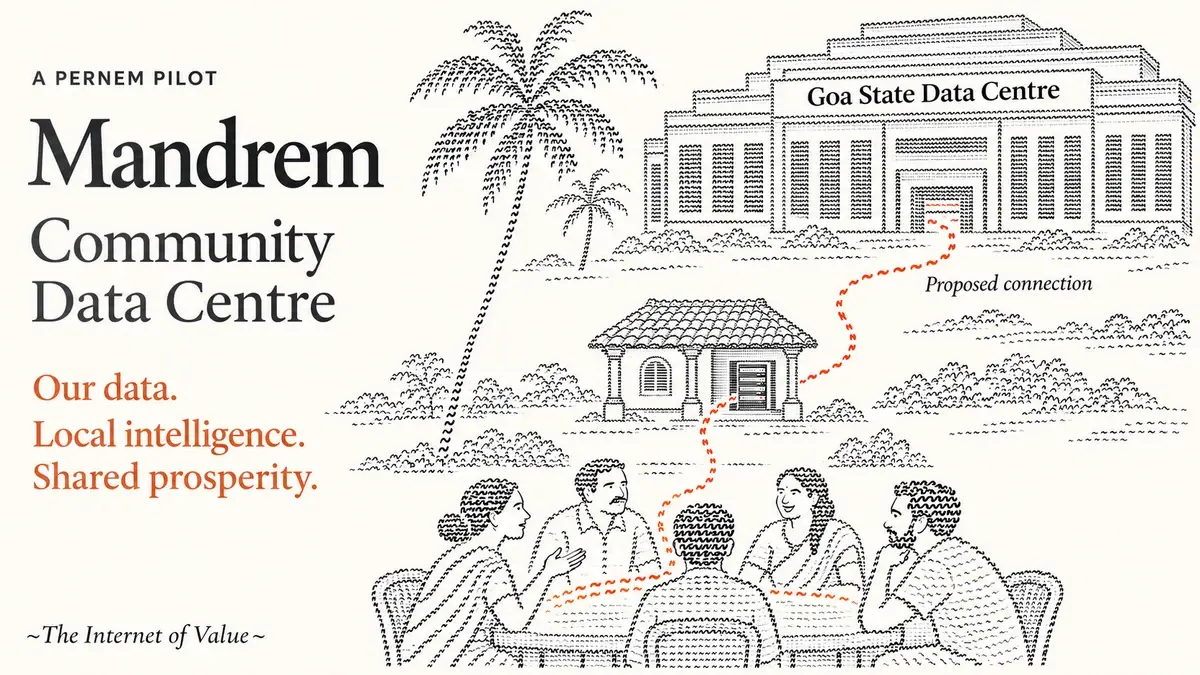
The cover shows a possible connection to larger public infrastructure. An interface or recovery arrangement would require the responsible institution’s authority and agreement. No connection is operating or contracted.